Soccer defending drills to teach proper defensive skills and team strategies.
soccer defending drillssoccer defensive practicessoccer defense skillsdefensive training sessions
Defending is a vital part of soccer that requires discipline, positioning, and teamwork to stop the opposition. This page provides drills to help players develop defensive skills such as tackling, marking, and intercepting to protect their goal effectively.
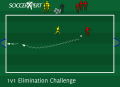
This drill sharpens 1v1 attacking, defending, and finishing under pressure. Players must react quickly after scoring, transition between attack and defense, and stay composed in high-pressure situations.
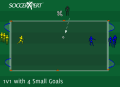
This drill improves 1v1 attacking skills, defensive positioning, and finishing under pressure. Players learn to recognize attacking opportunities while also being responsible for defending their assigned goals.
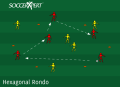
The Hexagonal Rondo drill focuses on quick passing and movement within a six-sided grid, emphasizing control and spatial awareness. Players work to maintain possession by creating passing angles and exploiting gaps in the defensive shape. The objective is to enhance technical precision, quick decision-making, and fluid team coordination.
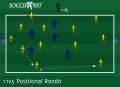
This drill teaches your full team to keep possession while maintaining positions on the field. Players learn where they should be in your formation and how to support teammates from their specific spot. The positional constraint forces players to understand spacing, passing lanes, and how their role fits into the team shape. The five defenders work hard in a numbers down situation, building fitness and pressing coordination. The attacking team of eleven develops patience in possession and learns to move the ball through different lines of the formation. Adding goals for the defenders creates real consequence for losing the ball, making players focus on smart decisions under pressure. This drill bridges the gap between basic possession work and full game situations.
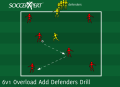
This drill builds players' ability to think quickly and adapt as defensive pressure increases. Starting easy with six attackers against one defender, the drill gets harder each time a new defender enters. Players learn to recognize space, make faster decisions, and adjust their positioning as numbers change. The attacking team develops creativity and problem solving skills as they figure out how to keep possession against growing pressure. Defenders work on coordination and learn to press as a unit. The transition element is huge because when the ball changes hands, players must instantly switch their mindset from attack to defense or defense to attack. This mirrors real game situations where numerical advantages shift and players need to respond immediately.
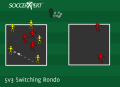
This drill trains players to recognize when possession is lost and react instantly by switching fields of play. The attacking team learns to keep the ball under pressure in tight spaces while the defending team works on winning possession and immediately playing forward. The switching element teaches players to read the game and anticipate transitions. Players must communicate who stays and who goes when the switch happens, building decision making skills under pressure. The numerical advantage for attackers creates confidence in possession while defenders learn to press intelligently when outnumbered. Moving between grids forces players to stay mentally engaged even when they're not directly involved in the current action. This back and forth rhythm mirrors real games where play shifts from one area of the field to another.
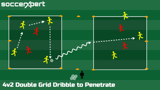
This drill builds the courage to dribble forward and the vision to combine once you get there. Most young players learn to keep the ball. Fewer learn when to carry it into space on purpose. Here, attackers hold a 4v2 advantage in one grid until a gap opens. Then one player has to make a bold read: drive the ball across open space into a second group and keep the play alive. It is a great tool for coaches who want players who dribble with a purpose, not just to beat a defender for the sake of it. Along the way, players practice supporting angles, scanning before the ball arrives, and staying patient in tight numbers-up possession. Add pass or touch restrictions once players get comfortable, and this drill turns into a real tactical test of speed of play and decision-making under pressure.
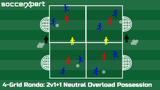
This drill builds two skills at once: tight possession play and the scanning habit every good midfielder needs. Attackers work 2v1 in a tight grid, so they must move the ball fast and support each other well. The real teaching point sits with the two neutral players. They have to read the game across two grids at once and decide, on their own, which team needs help right now. That is a decision soccer players make every match, and this drill forces it over and over in a small space. When a defender wins the ball, the drill flips instantly into a fast counter-attack on a small goal, so players also learn to transition the moment possession changes. Keep score with the point system and players will fight for every pass and every turnover.
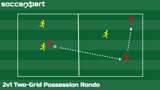
This drill sharpens your team's ability to keep the ball under pressure and use support. Two attackers face one defender in a tight grid. That is a real test of quick touches and quick thinking. When the defender wins the ball, they looks to link with his own attacker in the next grid to keep his team involved. Your attackers must think fast too. They can use the player in the next grid as an out ball, but that player only gets one or two touches. This forces sharp first touches, quick scanning, and constant movement to support the ball. It is a great drill for players who need work on tight combination play, fast decisions, and staying composed under pressure.
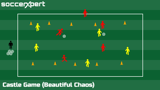
This game is chaos on purpose. Two balls are live at the same time, so players cannot lock onto one thing and switch their brain off. They have to scan, talk, and decide fast. That is the whole point. Each team guards five cones on their own end line. Each team tries to knock over the other team's cones with the ball. Knock one down, sprint it back to your castle, and it belongs to you. Simple rules, and the players get it in about thirty seconds. What you get out of it is much bigger than the rules suggest. Players learn to keep their head up because a second ball can hit them from behind. They learn to pick a pass instead of blasting it, because an accurate ball knocks a cone over and a wild one does not. They learn to shift from attack to defense in a heartbeat, since both happen at once. And the sprint rule turns this into real conditioning without a single line drill. Nobody stands around. Nobody asks how much longer. Use it as a warm-up, a mid-session energizer, or the last twenty minutes when legs are tired and you still want quality touches. It fits U6 all the way to adults. You only change the grid size and the number of balls. Coaches, resist the urge to over-coach this one. Let it get loud. Step in for a quick word, then let them play. The best learning here happens on its own, and the kids will ask for it again next week.
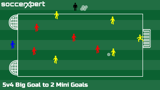
This game-like drill creates a high-tempo match situation to challenge both attackers and defenders. Attackers learn how to break through a compact defense to create finishing chances on the big goal. Defenders focus on applying pressure, staying compact in central spaces, and protecting the penalty area. When defenders win the ball, they must transition immediately to find the two mini goals or connect with the neutral target. The neutral player keeps the pace high and gives both teams an outlet to reset and switch the attack.
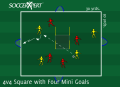
This drill develops players' vision and awareness by forcing them to constantly scan and recognize which goals are open for attack. The requirement to pass through the center poles before scoring teaches patience in possession and rewards teams that can control the ball and pick the right moment to penetrate. Players learn to open up their body position to see the entire field, including teammates making backside runs away from pressure. The four goals create constant decision-making about which direction to attack based on where defenders are positioned. Quick transitions become essential because once a team completes the pass through the center, they must immediately identify and attack an open goal before defenders can recover. This setup mimics games in which teams must recognize when to keep possession and when to strike quickly, and it rewards players who can switch the point of attack rapidly.
 EASY
EASY

 Premium