Browse and Discover the top soccer drills, advanced practices and soccer training sessions. These are the best soccer drills from years of exposure to top soccer coaches.
best Soccer drillstop Soccer drillsyouth Soccer trainingSoccer practice ideascoaching drills
Discover top-rated Soccer drills that enhance skills, teamwork, and game intelligence for youth players at all levels.
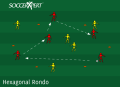
This drill builds the foundation of possession soccer by teaching players how to keep the ball in tight spaces. Players learn to create good angles of support, move intelligently without the ball, and position their bodies correctly when receiving. The small grid forces quick decisions and sharp passing. Attackers practice opening their hips to see the whole field and using their back foot to receive passes smoothly. The drill teaches deception through body feints and eye contact that mislead the defender. Players develop the speed and accuracy needed to move the ball before pressure arrives. The consequence of becoming the defender when you make a mistake keeps everyone focused and accountable. This simple but effective drill appears in training sessions from youth levels all the way up to professional teams.
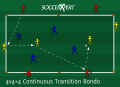
This drill builds players' ability to think quickly and adapt as defensive pressure increases. Starting easy with six attackers against one defender, the drill gets harder each time a new defender enters. Players learn to recognize space, make faster decisions, and adjust their positioning as numbers change. The attacking team develops creativity and problem solving skills as they figure out how to keep possession against growing pressure. Defenders work on coordination and learn to press as a unit. The transition element is huge because when the ball changes hands, players must instantly switch their mindset from attack to defense or defense to attack. This mirrors real game situations where numerical advantages shift and players need to respond immediately.
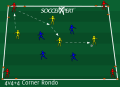
This drill trains players to recognize when possession is lost and react instantly by switching fields of play. The attacking team learns to keep the ball under pressure in tight spaces while the defending team works on winning possession and immediately playing forward. The switching element teaches players to read the game and anticipate transitions. Players must communicate who stays and who goes when the switch happens, building decision making skills under pressure. The numerical advantage for attackers creates confidence in possession while defenders learn to press intelligently when outnumbered. Moving between grids forces players to stay mentally engaged even when they're not directly involved in the current action. This back and forth rhythm mirrors real games where play shifts from one area of the field to another.
This game-like drill creates a high-tempo match situation to challenge both attackers and defenders. Attackers learn how to break through a compact defense to create finishing chances on the big goal. Defenders focus on applying pressure, staying compact in central spaces, and protecting the penalty area. When defenders win the ball, they must transition immediately to find the two mini goals or connect with the neutral target. The neutral player keeps the pace high and gives both teams an outlet to reset and switch the attack.
This game is chaos on purpose. Two balls are live at the same time, so players cannot lock onto one thing and switch their brain off. They have to scan, talk, and decide fast. That is the whole point. Each team guards five cones on their own end line. Each team tries to knock over the other team's cones with the ball. Knock one down, sprint it back to your castle, and it belongs to you. Simple rules, and the players get it in about thirty seconds. What you get out of it is much bigger than the rules suggest. Players learn to keep their head up because a second ball can hit them from behind. They learn to pick a pass instead of blasting it, because an accurate ball knocks a cone over and a wild one does not. They learn to shift from attack to defense in a heartbeat, since both happen at once. And the sprint rule turns this into real conditioning without a single line drill. Nobody stands around. Nobody asks how much longer. Use it as a warm-up, a mid-session energizer, or the last twenty minutes when legs are tired and you still want quality touches. It fits U6 all the way to adults. You only change the grid size and the number of balls. Coaches, resist the urge to over-coach this one. Let it get loud. Step in for a quick word, then let them play. The best learning here happens on its own, and the kids will ask for it again next week.
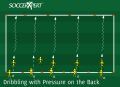
This drill enhances a player’s ability to move under pressure while maintaining balance and control. It also encourages teamwork and coordination among defenders using their hips to contain the central player.
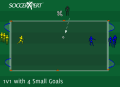
Develops dribbling under pressure, decision-making in 1v1 situations, and ball protection. Players learn to change direction and use feints to evade defenders.
Develops attacking players' ability to exploit numerical advantages in a 2v1 situation. Encourages defenders to delay and disrupt play while improving goalkeeper distribution and decision-making.
This drill improves small-group attacking and defending, finishing under pressure, and goalkeeper distribution. It simulates game-like conditions in a compact space, encouraging quick decisions and dynamic play.
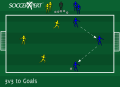
This drill simulates real match conditions by developing players' ability to attack, defend, and transition in small-sided play. It encourages quick decision-making, team communication, and finishing with the added challenge of goalkeepers.
This drill improves a player's ability to protect the ball while dribbling under pressure. It teaches awareness, quick reactions, and body positioning to maintain possession against a defender.
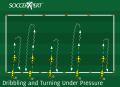
This drill teaches players how to turn effectively when under defensive pressure. It improves awareness, body positioning, and ball protection while developing confidence in 1v1 situations.