Search soccer drills by age and drill type to plan the perfect practice.
To filter these results, use the dropdown menus below to choose the age range and drill topic.
Soccer Drill Search
Soccer Drill Search Help
To search for soccer drills by soccer drill type, choose a type and press search.
To search by age, choose an age and press search. To search by both type and age,
choose a drill type and age and press search.
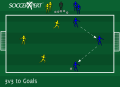
This drill develops players' ability to attack and defend in small spaces while encouraging quick decision-making, teamwork, and fitness through constant movement.
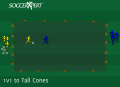
This drill develops individual attacking and defending skills by challenging players to dribble under pressure, protect the ball, and accurately pass or shoot to knock over cones for points.
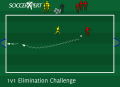
This drill sharpens 1v1 attacking, defending, and finishing under pressure. Players must react quickly after scoring, transition between attack and defense, and stay composed in high-pressure situations.
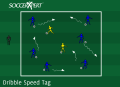
This drill enhances dribbling under pressure, quick changes of direction, and spatial awareness. Players learn to protect the ball while navigating through a crowded area at speed.
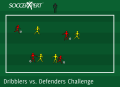
This drill develops dribbling under pressure, defensive tackling skills, and quick decision-making. Dribblers learn to protect the ball while defenders work on pressing and winning possession.
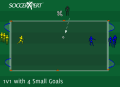
This drill improves 1v1 attacking skills, defensive positioning, and finishing under pressure. Players learn to recognize attacking opportunities while also being responsible for defending their assigned goals.
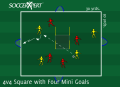
This drill develops players' vision and awareness by forcing them to constantly scan and recognize which goals are open for attack. The requirement to pass through the center poles before scoring teaches patience in possession and rewards teams that can control the ball and pick the right moment to penetrate. Players learn to open up their body position to see the entire field, including teammates making backside runs away from pressure. The four goals create constant decision-making about which direction to attack based on where defenders are positioned. Quick transitions become essential because once a team completes the pass through the center, they must immediately identify and attack an open goal before defenders can recover. This setup mimics games in which teams must recognize when to keep possession and when to strike quickly, and it rewards players who can switch the point of attack rapidly.
 MEDIUM

 Premium