Objective
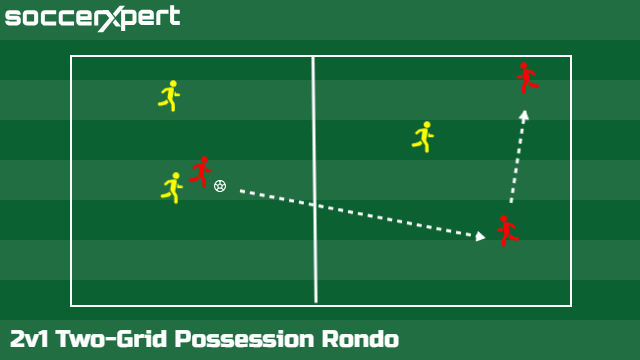
This drill sharpens your team's ability to keep the ball under pressure and use support. Two attackers face one defender in a tight grid. That is a real test of quick touches and quick thinking. When the defender wins the ball, they looks to link with his own attacker in the next grid to keep his team involved. Your attackers must think fast too. They can use the player in the next grid as an out ball, but that player only gets one or two touches. This forces sharp first touches, quick scanning, and constant movement to support the ball. It is a great drill for players who need work on tight combination play, fast decisions, and staying composed under pressure.
Equipment Needed
Setup
- Mark out a grid 8 yards wide by 12 yards long.
- Divide the grid in half to create two connected grids, each 8x6 yards.
- Split 6 players into two teams of 3.
- Place 2 attackers from one team and 1 defender from the other team in each grid.
- Use cones to mark the outer grid lines and the dividing line between grids.
- One ball to start play.
Instructions
- Start the ball with the two attackers in one grid.
- The two attackers combine with quick passes and movement to keep the ball away from the lone defender.
- If the defender wins the ball, he plays it into his own attacker waiting in the adjacent grid.
- Attackers can also use their teammate in the adjacent grid as an outlet to escape pressure.
- The player receiving in the adjacent grid must play in one or two touches and return the ball to the original grid right away.
- Play continues back and forth between grids as attackers look to string passes together.
- Award a point to a team after they complete a set number of consecutive passes, for example 5 or 7.
- Reset with a new ball and rotate defenders after each point or after a set time, such as 90 seconds.
Coaching Points
- Constant movement: in a 2v1, the free attacker must always adjust position to open a passing angle.
- No standing on the line: players waiting in the next grid should stay ready, not parked on the dividing line.
- Quick 1-2 touch play: the link player must play fast, or the defender will recover and close the gap.
- Scan before receiving: attackers should check over their shoulder before the ball arrives so they already know their next pass.
- Body shape: receive on the back foot or half-turned so the next pass is already open.
- Communication: attackers should call for the ball early and loud to speed up decisions.
Variations
- Add a second ball to force even faster decision-making and communication.
- Limit attackers to two touches to raise the difficulty.
- Allow the defender to follow into the adjacent grid on a turnover, making it a fluid 2v2 for advanced groups.
- Shrink the grid size to tighten space and increase pressure.
- Raise the passing count needed to score to extend possession sequences.
Coach's Tip: Train Vision & Scanning
Use the free SoccerXpert Scanning App during this drill to flash colors or numbers, forcing players to shoulder-check and scan before receiving.

 Premium
