Objective
This drill builds the courage to dribble forward and the vision to combine once you get there. Most young players learn to keep the ball. Fewer learn when to carry it into space on purpose. Here, attackers hold a 4v2 advantage in one grid until a gap opens. Then one player has to make a bold read: drive the ball across open space into a second group and keep the play alive. It is a great tool for coaches who want players who dribble with a purpose, not just to beat a defender for the sake of it. Along the way, players practice supporting angles, scanning before the ball arrives, and staying patient in tight numbers-up possession. Add pass or touch restrictions once players get comfortable, and this drill turns into a real tactical test of speed of play and decision-making under pressure.
Equipment Needed
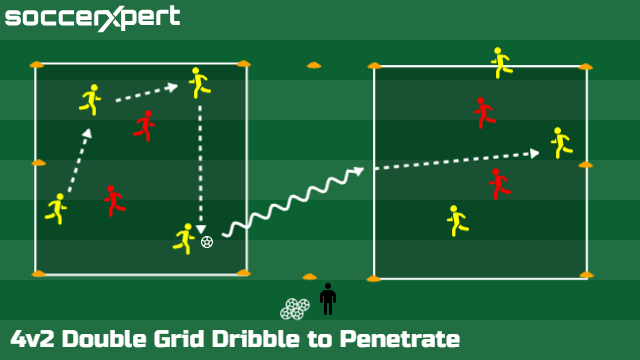
Setup
- Set up two 12x12 yard grids using cones, spaced 10-12 yards apart with open space between them.
- Equipment: cones for grid boundaries, yellow bibs for attackers, red bibs for defenders, and several soccer balls for quick restarts.
- 11 players total: 7 attackers in yellow, 4 defenders in red.
- Place 4 attackers and 2 defenders in the first grid.
- Place 3 attackers and 2 defenders in the second grid.
- Play starts with the ball in the first grid, where attackers hold the 4v2 advantage.
Instructions
- Start the ball with the 4 attackers in the first grid. They keep possession using short passes and movement, working the 4v2 advantage.
- Defenders in each grid only defend inside their own grid. They do not chase the ball into the space between the grids.
- When an attacker sees an opening, they dribble out of the first grid, across the open space, and into the second grid.
- As the dribbler approaches the second grid, the 3 attackers already there must open passing lanes and offer the dribbler an easy pass in.
- Once the dribbler plays the ball into the second grid, the group there now has 4 attackers against 2 defenders, and possession continues.
- The grid the dribbler just left now has 3 attackers left. Play continues there with defenders looking to win the ball back.
- Keep a running tally of defender wins across both grids, whether from an interception, a tackle, or the ball going out of bounds.
- Once defenders combine for 10 wins, rotate in a fresh pair of defenders in each grid and reset the tally.
Coaching Points
- Watch that defenders stay disciplined and do not track the dribbler out of their own grid. This keeps the numbers-up advantage fair in both grids.
- Coach dribblers to pick their head up before they cross the open space, so they arrive already knowing where the pass will go.
- Remind attackers waiting in the second grid to keep moving. A standing target is an easy read for defenders and closes the passing lane.
- Look for attackers dribbling too early, before real space opens. The 4v2 advantage should be used to draw defenders first.
- Encourage players to communicate. A simple call like "here" or "gap" helps the dribbler commit with confidence.
- If dribblers are getting caught in the open space, the grids may be too far apart, or players are not scanning before they go.
Variations
- My favorite, add a third defender to one of the grids and allow the defender to track the attacker across the zone to create a 4v3.
- Limit attackers to a set number of passes, such as 3 or fewer, before someone must dribble across the space.
- Add a 2-touch restriction inside the grids to force quicker movement and sharper passing.
- Add a 1-touch restriction for advanced groups to raise the tempo even further.
- Swap in a rule where the dribbler must finish with a specific pass type, like a firm ground pass or a first-time lay-off.
- Reduce the space between grids to make the dribble riskier, or extend it to reward composure on the ball.

 Premium
