Objective
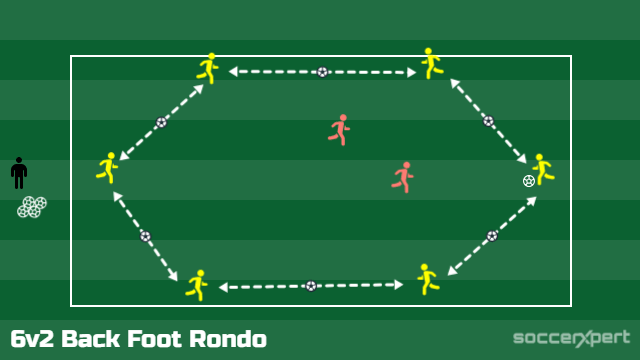
This 6v2 rondo keeps eight players busy in one small grid and teaches a habit every good passer needs. Players cannot pass across the grid. The ball can only go to the teammate next to them, on the left or the right. That rule forces players to open up and receive with the back foot so the ball keeps moving around the grid. I like this version for bigger groups because six attackers give the ball plenty of places to go, but only if players set their body shape early. A player who faces the passer gets closed down fast by two defenders. A player who opens the hips and takes the first touch across the body moves the ball on with no fuss. You will see quicker ball speed, sharper first touches, and players who look before they receive. The two defenders get a real workout too, and they learn to press as a pair.
Equipment Needed
Setup
- Mark out an 8x15 yard rectangle with four cones.
- Place six attackers inside the grid. Put two on each long side and one on each short end.
- Space the two attackers on each long side about 6 to 7 yards apart.
- Place two defenders inside the grid and give them bibs.
- Use one ball per grid and keep a few spare balls close by for fast restarts.
- No goals or goalkeepers are needed.
- For bigger squads, build one grid for every eight players.
Instructions
- Start the ball with any attacker on the inside of the grid.
- The six attackers pass the ball around the grid and try to keep it away from the two defenders.
- Attackers can only pass to the teammate next to them, on their left or their right. Passes across the grid are not allowed.
- Attackers can slide along their own line to open a passing lane, but they stay inside the grid.
- Ask each player to receive with the back foot, the foot furthest from the ball, so the first touch moves toward the next teammate.
- Players can send the ball back the way it came at any time. Changing direction is the best way to beat the press.
- The two defenders work together to win the ball or force a bad pass out of the grid.
- When a defender wins the ball, or a pass leaves the area, that defender swaps with the attacker who made the mistake. If it is not clear who won it, the defender who has been in longest comes out.
- Attackers score one point for every 8 passes in a row. If the same two defenders stay in for 60 seconds, swap in a fresh pair.
- Play for 15 minutes with short water breaks. Move players to new spots often so everyone works on both feet.
Coaching Points
- Open the body before the ball arrives. Hips should face the middle of the grid, not the passer.
- Receive with the back foot so the first touch sets up the next pass.
- Pass firm and on the ground to the back foot of the teammate.
- Look over the shoulder before the ball comes. Know where the defenders are and which way to play.
- Change direction when the defenders close one side. Players should not force the ball into pressure.
- Move along the line to give the passer a clear lane. The end players have the most work to do here.
- Watch for players who stop the ball dead under their body. Freeze play, show the open body shape, and restart.
- Coach the defenders to work as a pair. One presses the ball and the other cuts off the next pass.
Variations
- Limit attackers to two touches. One touch to receive and one touch to pass.
- Go one touch for strong groups that keep the ball with ease.
- Make the grid bigger, such as 10x18 yards, to give newer players more time on the ball.
- Make the grid smaller to raise the pressure on first touch and speed of play.
- Add a third defender for a 6v3 game that tests strong groups.
- Give the attackers a bonus point each time they change direction and still reach 8 passes.
- Let defenders who win the ball try to dribble out of the grid for a point. The attackers must react fast to win it back.

 Premium
