Objective
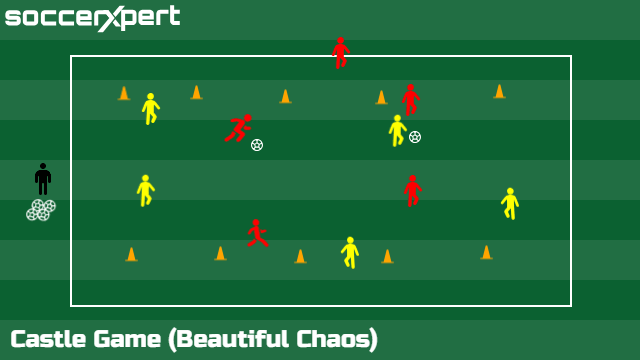
This game is chaos on purpose. Two balls are live at the same time, so players cannot lock onto one thing and switch their brain off. They have to scan, talk, and decide fast. That is the whole point. Each team guards five cones on their own end line. Each team tries to knock over the other team's cones with the ball. Knock one down, sprint it back to your castle, and it belongs to you. Simple rules, and the players get it in about thirty seconds. What you get out of it is much bigger than the rules suggest. Players learn to keep their head up because a second ball can hit them from behind. They learn to pick a pass instead of blasting it, because an accurate ball knocks a cone over and a wild one does not. They learn to shift from attack to defense in a heartbeat, since both happen at once. And the sprint rule turns this into real conditioning without a single line drill. Nobody stands around. Nobody asks how much longer. Use it as a warm-up, a mid-session energizer, or the last twenty minutes when legs are tired and you still want quality touches. It fits U6 all the way to adults. You only change the grid size and the number of balls. Coaches, resist the urge to over-coach this one. Let it get loud. Step in for a quick word, then let them play. The best learning here happens on its own, and the kids will ask for it again next week.
Equipment Needed
Setup
- Mark a large rectangle. Use 35x50 yards for U16 through adult, 30x40 for U14, 25x35 for U12, 20x30 for U10, and 15x20 for U6 to U8.
- Place five cones spread evenly along each end line. These are the castle cones each team defends.
- Mark a small square just outside each end line as that team's castle. Won cones get stacked there.
- Split into two even teams, five versus five or six versus six. Use two colors of bibs.
- Start with two balls in play, one per team.
- Keep three or four spare balls on each sideline so play never stops.
- No goalkeepers. No goals needed.
Instructions
- Give each team a side. Their five end line cones are their castle cones to defend.
- Start the game with two balls, one for each team.
- Teams try to knock over the other team's cones by striking them with the ball. A pass or a shot both count.
- When a cone goes down from the ball, the attacking team's closest player picks it up and sprints it back to their own castle.
- The player must sprint the whole way. If they jog it back, the cone does not count. Send them back to stand it up again.
- Players can play on both sides of the cone line. Attack from behind the cones or in front of them.
- If a cone gets knocked over by a foot, knee, or body instead of the ball, stand it back up and play on. No stoppage.
- Balls that leave the grid are replaced right away from the sideline. Keep two balls live at all times.
- Teams defend and attack at the same time. There are no set positions and no set roles.
- Play for time, or until one team wins all five of the other team's cones. Count the castles to find the winner.
Coaching Points
- Heads up. Two balls means two threats. Ask players how many times they scanned before their last touch.
- Reward accuracy over power. A firm, low pass knocks a cone down. A blasted ball flies over it.
- Watch the team balance. If everyone attacks, their castle gets stripped. If everyone defends, they never score.
- Call out players who stand and watch. Bodies moving, eyes moving.
- Coach body shape. Open the hips so they can see the ball and the far cones at the same time.
- Push talking. Short calls work best here. Names, not noise.
- Common mistake: dribbling straight into a crowd. Show them the quick pass around the outside instead.
- Common mistake: jogging the cone back. Hold the sprint rule from the first minute or it disappears.
- Praise the player who defends a cone by winning the ball early instead of standing in front of it.
Variations
- Add a third ball once players handle two. The scanning demand jumps right away.
- Two-touch maximum. Forces faster heads and quicker decisions.
- Weak foot only for shots at cones. Great for U12 and up.
- A cone only counts if it goes down from a first-time pass off a teammate. Builds combination play.
- Set a shooting line five yards out. Cones must be struck from outside it, so nobody camps on the end line.
- Continuous version: stand every cone back up right away and just count total cones won in the castle. Highest fitness load.
- Add a goal and a keeper on one end for a mixed finishing and awareness game.
- For U6 to U8, use one ball and three cones per team. Keep the grid small and the rules short.
- Play four rounds of four minutes with two minutes rest. Track the score across rounds to keep the intensity honest.

 Premium
