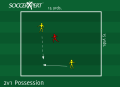
This drill sharpens players' ability to keep the ball when space is limited and pressure is immediate. Two attackers work together against one defender, forcing quick decisions and accurate passing in tight quarters. Players learn to use first time passes when appropriate and develop the vision to see their teammate's movement before receiving the ball. The confined area means there's no room for heavy touches or slow decisions. Attackers build chemistry by reading each other's body language and creating passing angles through constant movement. The defender learns to apply smart pressure that forces mistakes without getting beaten by a simple pass. This situation mirrors game moments when players receive in crowded areas and must quickly combine with a teammate to maintain possession and build play forward.
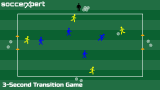
The first three seconds after a turnover are the most important moments in any game. This drill puts your players right in the middle of that chaos and trains them to handle it.
When a team wins the ball, the clock starts. They have three seconds to complete three passes or attack a target gate. That pressure forces fast thinking, quick movement, and clear communication.
On the flip side, the team that just lost possession has to react just as fast. No standing still. No watching. They need to press, close space, and get compact before the other team can hurt them.
This is a game-like drill that builds real habits. Players stop drifting and start making sharp, confident decisions at the exact moment it matters most. Run it often and you will see those habits show up on match day.
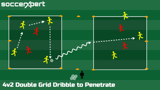
This drill builds the courage to dribble forward and the vision to combine once you get there. Most young players learn to keep the ball. Fewer learn when to carry it into space on purpose. Here, attackers hold a 4v2 advantage in one grid until a gap opens. Then one player has to make a bold read: drive the ball across open space into a second group and keep the play alive. It is a great tool for coaches who want players who dribble with a purpose, not just to beat a defender for the sake of it. Along the way, players practice supporting angles, scanning before the ball arrives, and staying patient in tight numbers-up possession. Add pass or touch restrictions once players get comfortable, and this drill turns into a real tactical test of speed of play and decision-making under pressure.
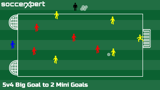
This game-like drill creates a high-tempo match situation to challenge both attackers and defenders. Attackers learn how to break through a compact defense to create finishing chances on the big goal. Defenders focus on applying pressure, staying compact in central spaces, and protecting the penalty area. When defenders win the ball, they must transition immediately to find the two mini goals or connect with the neutral target. The neutral player keeps the pace high and gives both teams an outlet to reset and switch the attack.
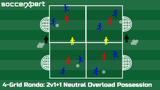
This drill builds two skills at once: tight possession play and the scanning habit every good midfielder needs. Attackers work 2v1 in a tight grid, so they must move the ball fast and support each other well. The real teaching point sits with the two neutral players. They have to read the game across two grids at once and decide, on their own, which team needs help right now. That is a decision soccer players make every match, and this drill forces it over and over in a small space. When a defender wins the ball, the drill flips instantly into a fast counter-attack on a small goal, so players also learn to transition the moment possession changes. Keep score with the point system and players will fight for every pass and every turnover.
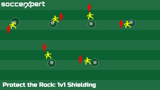
This game teaches your youngest players one of the most useful skills in soccer: shielding the ball. One player stands over the ball like it's a treasure they must guard. The other player tries to knock it away. The defender learns to use their body, not their hands, to keep the attacker out. It is simple, it is active, and every player touches the ball on every single turn. Coaches love it because it needs almost no setup and keeps kids moving the whole time.
 MEDIUM

 Premium