Quality age-appropriate soccer drills for kids in the U17, U18, U19, U20, and Older age group.
Under 17 + Soccer DrillsGamesand Exercises
Soccer drills for players ages 17 and up focus on mastering advanced techniques and tactical strategies for competitive play. This page provides drills designed to enhance technical precision, game intelligence, and physical conditioning to compete at higher levels.
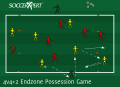
This drill develops players' ability to keep possession under pressure while moving the ball quickly and effectively. Players learn to scan the field, find open teammates in different zones, and make smart decisions about when to pass and when to dribble. The endzone players teach awareness of supporting options behind the defense. Neutral players on the sides create overloads that mirror real game situations. Players work on their first touch, receiving skills, and passing accuracy while constantly moving to create passing lanes. The progression from simple possession to scoring through the endzones builds complexity as players improve.
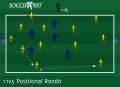
This drill teaches your full team to keep possession while maintaining positions on the field. Players learn where they should be in your formation and how to support teammates from their specific spot. The positional constraint forces players to understand spacing, passing lanes, and how their role fits into the team shape. The five defenders work hard in a numbers down situation, building fitness and pressing coordination. The attacking team of eleven develops patience in possession and learns to move the ball through different lines of the formation. Adding goals for the defenders creates real consequence for losing the ball, making players focus on smart decisions under pressure. This drill bridges the gap between basic possession work and full game situations.
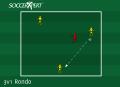
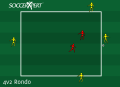
This drill builds the foundation of possession soccer by teaching players how to keep the ball in tight spaces. Players learn to create good angles of support, move intelligently without the ball, and position their bodies correctly when receiving. The small grid forces quick decisions and sharp passing. Attackers practice opening their hips to see the whole field and using their back foot to receive passes smoothly. The drill teaches deception through body feints and eye contact that mislead the defender. Players develop the speed and accuracy needed to move the ball before pressure arrives. The consequence of becoming the defender when you make a mistake keeps everyone focused and accountable. This simple but effective drill appears in training sessions from youth levels all the way up to professional teams.
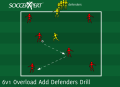
This drill builds players' ability to think quickly and adapt as defensive pressure increases. Starting easy with six attackers against one defender, the drill gets harder each time a new defender enters. Players learn to recognize space, make faster decisions, and adjust their positioning as numbers change. The attacking team develops creativity and problem solving skills as they figure out how to keep possession against growing pressure. Defenders work on coordination and learn to press as a unit. The transition element is huge because when the ball changes hands, players must instantly switch their mindset from attack to defense or defense to attack. This mirrors real game situations where numerical advantages shift and players need to respond immediately.
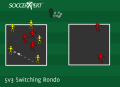
This drill trains players to recognize when possession is lost and react instantly by switching fields of play. The attacking team learns to keep the ball under pressure in tight spaces while the defending team works on winning possession and immediately playing forward. The switching element teaches players to read the game and anticipate transitions. Players must communicate who stays and who goes when the switch happens, building decision making skills under pressure. The numerical advantage for attackers creates confidence in possession while defenders learn to press intelligently when outnumbered. Moving between grids forces players to stay mentally engaged even when they're not directly involved in the current action. This back and forth rhythm mirrors real games where play shifts from one area of the field to another.
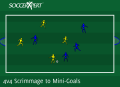
The objective of a 4v4 soccer scrimmage to mini-goals is to replicate the dynamics of a full-sided game in a smaller, more controlled environment. This format encourages players to focus on quick decision-making, positioning, and maintaining possession under pressure, as well as improving their ability to transition between attacking and defending. The mini-goals emphasize accuracy and composure in front of the goal, helping players develop finishing skills without the presence of a goalkeeper.
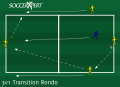
The 3v1 Transition Rondo drill emphasizes quick combination passing to unbalance the defender and shift the point of attack to an adjacent grid. This exercise challenges the defender to transition rapidly between areas, enhancing their ability to react under pressure. The focus is on sharp passing and strategic movement to exploit defensive weaknesses.
The three-cone passing drill focuses on passing, awareness, and movement after the pass. This is a great warmup to focus on passing technique and movement after the pass.
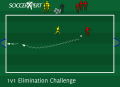
This drill sharpens 1v1 attacking, defending, and finishing under pressure. Players must react quickly after scoring, transition between attack and defense, and stay composed in high-pressure situations.
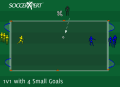
This drill improves 1v1 attacking skills, defensive positioning, and finishing under pressure. Players learn to recognize attacking opportunities while also being responsible for defending their assigned goals.
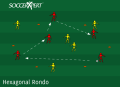
The Hexagonal Rondo drill focuses on quick passing and movement within a six-sided grid, emphasizing control and spatial awareness. Players work to maintain possession by creating passing angles and exploiting gaps in the defensive shape. The objective is to enhance technical precision, quick decision-making, and fluid team coordination.
 MEDIUM

 Premium