Browse U9, U10, U11, & U12 Soccer Drills and Soccer Practice Sessions
Under 9Under 10Under 11and Under 12 Soccer Drills (U9U10U11& U12 Soccer Drills)U9 U10 U11 U12 Soccer Practice Sessions
When coaching Under 9, Under 10, Under 11, and Under 12, the player's motor skills are becoming more refined. Most players can stay on task at a greater length allowing you to extend your practices to an hour and a half or, in some instances, competitive team environments, two hours. You will notice skills starting to emerge, and the repetition of technique is essential. Coaches should continue positive reinforcement as peer pressure is starting to become an issue.
With the player's technique learned at an earlier age is now time to refine these skills with an introduction to basic tactics. Small-sided games will become your primary teaching means. With small-sided games such as 1v1, 2v2, 3v3, and 4v4, players will receive tons of touches while focusing on less complicated tactics than a 11v11 match.
My #1 piece of advice is to play small-sided games and put an emphasis on creating a competitive environment as much as possible. This will keep the small-sided games fun for the players and teach the game itself.
The soccer drills listed below are age specific soccer drills for Under 9 (U9, U-9, 9 and Under), Under 10 (U10, U-10, 10 and Under), Under 11 (U11, U-11, and 11 and Under), Under 12 (U12, U-12, 12 and Under).
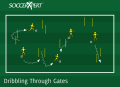
Develop players' dribbling skills by challenging them to navigate through multiple gates within a 1-minute timeframe. This drill emphasizes quick decision-making and ball control under pressure. The goal is to enhance agility and precision while maintaining speed during dribbling.
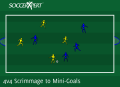
The objective of a 4v4 soccer scrimmage to mini-goals is to replicate the dynamics of a full-sided game in a smaller, more controlled environment. This format encourages players to focus on quick decision-making, positioning, and maintaining possession under pressure, as well as improving their ability to transition between attacking and defending. The mini-goals emphasize accuracy and composure in front of the goal, helping players develop finishing skills without the presence of a goalkeeper.
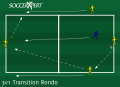
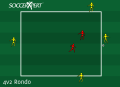
The 3v1 Transition Rondo drill emphasizes quick combination passing to unbalance the defender and shift the point of attack to an adjacent grid. This exercise challenges the defender to transition rapidly between areas, enhancing their ability to react under pressure. The focus is on sharp passing and strategic movement to exploit defensive weaknesses.
The three-cone passing drill focuses on passing, awareness, and movement after the pass. This is a great warmup to focus on passing technique and movement after the pass.
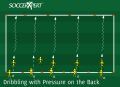
This drill improves a player's ability to protect the ball while dribbling under pressure. It teaches awareness, quick reactions, and body positioning to maintain possession against a defender.
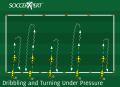
This drill teaches players how to turn effectively when under defensive pressure. It improves awareness, body positioning, and ball protection while developing confidence in 1v1 situations.
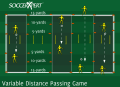
This drill improves passing accuracy, technique, and decision-making at varying distances. Players learn to adjust power and precision while maintaining consistency under pressure.
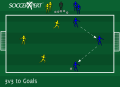
This drill develops players' ability to attack and defend in small spaces while encouraging quick decision-making, teamwork, and fitness through constant movement.
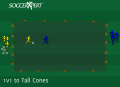
This drill develops individual attacking and defending skills by challenging players to dribble under pressure, protect the ball, and accurately pass or shoot to knock over cones for points.
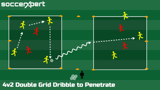
This drill builds the courage to dribble forward and the vision to combine once you get there. Most young players learn to keep the ball. Fewer learn when to carry it into space on purpose. Here, attackers hold a 4v2 advantage in one grid until a gap opens. Then one player has to make a bold read: drive the ball across open space into a second group and keep the play alive. It is a great tool for coaches who want players who dribble with a purpose, not just to beat a defender for the sake of it. Along the way, players practice supporting angles, scanning before the ball arrives, and staying patient in tight numbers-up possession. Add pass or touch restrictions once players get comfortable, and this drill turns into a real tactical test of speed of play and decision-making under pressure.
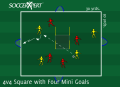
This drill develops players' vision and awareness by forcing them to constantly scan and recognize which goals are open for attack. The requirement to pass through the center poles before scoring teaches patience in possession and rewards teams that can control the ball and pick the right moment to penetrate. Players learn to open up their body position to see the entire field, including teammates making backside runs away from pressure. The four goals create constant decision-making about which direction to attack based on where defenders are positioned. Quick transitions become essential because once a team completes the pass through the center, they must immediately identify and attack an open goal before defenders can recover. This setup mimics games in which teams must recognize when to keep possession and when to strike quickly, and it rewards players who can switch the point of attack rapidly.
 Easy
Easy

 Premium