1v1 Attacking to a Full-Size Goal
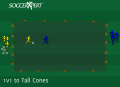
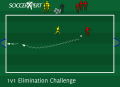
This 1v1 attacking drill that focuses on beating the defender in a 1v1 situation and finishing on a full-size goal.
Enhance your dribbling skills with these effective soccer drills. Perfect for all levels, these drills focus on ball control, agility, and technique. Start improving today!
Dribbling is a fundamental soccer skill that helps players maintain possession, evade defenders, and create scoring opportunities. This page offers a variety of drills to improve ball control, agility, and confidence in game-like situations.
This 1v1 attacking drill that focuses on beating the defender in a 1v1 situation and finishing on a full-size goal.
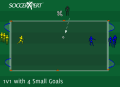
This drill develops players' vision and awareness by forcing them to constantly scan and recognize which goals are open for attack. The requirement to pass through the center poles before scoring teaches patience in possession and rewards teams that can control the ball and pick the right moment to penetrate. Players learn to open up their body position to see the entire field, including teammates making backside runs away from pressure. The four goals create constant decision-making about which direction to attack based on where defenders are positioned. Quick transitions become essential because once a team completes the pass through the center, they must immediately identify and attack an open goal before defenders can recover. This setup mimics games in which teams must recognize when to keep possession and when to strike quickly, and it rewards players who can switch the point of attack rapidly.
This drill builds fundamental ball mastery and comfort on the ball through unlimited touches and creative exploration. Players develop a natural feel for the ball by using all surfaces of their feet without the pressure of structured patterns or defenders. The confined space demands close control and quick adjustments, which translate directly into tight game situations. By encouraging experimentation with different moves and feints, players discover what works for their style and build confidence to try skills in actual games. Keeping their heads up while dribbling fosters awareness, helping players see teammates and opponents during matches. The freestyle environment removes the fear of mistakes and lets players push their limits, where real skill development happens. This drill is perfect for warming up because it gives players plenty of touches on the ball while allowing them to express themselves and have fun.
This drill builds the courage to dribble forward and the vision to combine once you get there. Most young players learn to keep the ball. Fewer learn when to carry it into space on purpose. Here, attackers hold a 4v2 advantage in one grid until a gap opens. Then one player has to make a bold read: drive the ball across open space into a second group and keep the play alive. It is a great tool for coaches who want players who dribble with a purpose, not just to beat a defender for the sake of it. Along the way, players practice supporting angles, scanning before the ball arrives, and staying patient in tight numbers-up possession. Add pass or touch restrictions once players get comfortable, and this drill turns into a real tactical test of speed of play and decision-making under pressure.
This drill teaches your full team to keep possession while maintaining positions on the field. Players learn where they should be in your formation and how to support teammates from their specific spot. The positional constraint forces players to understand spacing, passing lanes, and how their role fits into the team shape. The five defenders work hard in a numbers down situation, building fitness and pressing coordination. The attacking team of eleven develops patience in possession and learns to move the ball through different lines of the formation. Adding goals for the defenders creates real consequence for losing the ball, making players focus on smart decisions under pressure. This drill bridges the gap between basic possession work and full game situations.
This drill builds players' ability to think quickly and adapt as defensive pressure increases. Starting easy with six attackers against one defender, the drill gets harder each time a new defender enters. Players learn to recognize space, make faster decisions, and adjust their positioning as numbers change. The attacking team develops creativity and problem solving skills as they figure out how to keep possession against growing pressure. Defenders work on coordination and learn to press as a unit. The transition element is huge because when the ball changes hands, players must instantly switch their mindset from attack to defense or defense to attack. This mirrors real game situations where numerical advantages shift and players need to respond immediately.
This drill trains players to recognize when possession is lost and react instantly by switching fields of play. The attacking team learns to keep the ball under pressure in tight spaces while the defending team works on winning possession and immediately playing forward. The switching element teaches players to read the game and anticipate transitions. Players must communicate who stays and who goes when the switch happens, building decision making skills under pressure. The numerical advantage for attackers creates confidence in possession while defenders learn to press intelligently when outnumbered. Moving between grids forces players to stay mentally engaged even when they're not directly involved in the current action. This back and forth rhythm mirrors real games where play shifts from one area of the field to another.
This drill develops players' ability to keep possession under pressure while moving the ball quickly and effectively. Players learn to scan the field, find open teammates in different zones, and make smart decisions about when to pass and when to dribble. The endzone players teach awareness of supporting options behind the defense. Neutral players on the sides create overloads that mirror real game situations. Players work on their first touch, receiving skills, and passing accuracy while constantly moving to create passing lanes. The progression from simple possession to scoring through the endzones builds complexity as players improve.
The Hexagonal Rondo drill focuses on quick passing and movement within a six-sided grid, emphasizing control and spatial awareness. Players work to maintain possession by creating passing angles and exploiting gaps in the defensive shape. The objective is to enhance technical precision, quick decision-making, and fluid team coordination.