 EASY
EASY
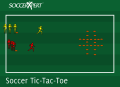
Soccer Tic-Tac-Toe Warm-up
Soccer Tic-Tac-Toe is a fun warmup drill that focuses on making good decisions while under pressure.
9+ yrs.
6+ players
10 mins.
20X20 yds.
GK: no
Browse and Discover the top soccer drills, advanced practices and soccer training sessions. These are the best soccer drills from years of exposure to top soccer coaches.
Discover top-rated Soccer drills that enhance skills, teamwork, and game intelligence for youth players at all levels.
EASY
Soccer Tic-Tac-Toe is a fun warmup drill that focuses on making good decisions while under pressure.
 MEDIUM
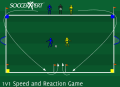
This 1v1 Speed and Reaction Game is a fun addition to any practice that focuses on quick reaction and speed, ending with a 1v1 to small goals.
 MEDIUM
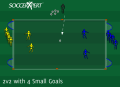
This drill enhances small-group play by developing combination play, defensive communication, and finishing under pressure. Players work on quick transitions between attack and defense in a game-like setting.
 MEDIUM
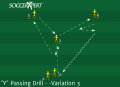
Develops players' ability to execute quick one-two passes, play accurate long balls, and transition into new positions efficiently. Encourages decision-making and proper body positioning for receiving and distributing passes.
 EASY
EASY
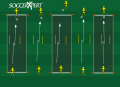
This drill helps players develop passing accuracy, weight of pass, and first-touch control. It also reinforces teamwork and focus while progressively increasing difficulty by narrowing the passing gate.
 Easy
Easy
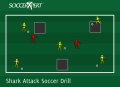
The Shark Attack drill is excellent for developing dribbling skills in a fun and engaging environment, encouraging young players to think and move quickly while maintaining control of the ball. This drill will help improve dribbling skills under pressure and to develop spatial awareness and agility.
 Easy
Easy
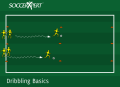
This soccer dribbling drill is fundamental to young player's development, laying the foundation for more advanced dribbling skills. Keeping the environment fun and encouraging is important, allowing players to build confidence in their ball-handling abilities. This drill introduces and improves basic dribbling skills and helps develop coordination and control of the ball with both feet.
 MEDIUM
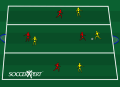
This 4v4 drill is great for improving shape and positioning. Each player has their own responsibility: 1) attacker/target player stretches the field closer to the goal they are attacking. 2) winger players stretch the width of the field. 3) defensive player gives support to wingers and target player while staying the last man.
 Hard
Hard
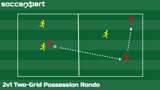
This drill sharpens your team's ability to keep the ball under pressure and use support. Two attackers face one defender in a tight grid. That is a real test of quick touches and quick thinking. When the defender wins the ball, they looks to link with his own attacker in the next grid to keep his team involved. Your attackers must think fast too. They can use the player in the next grid as an out ball, but that player only gets one or two touches. This forces sharp first touches, quick scanning, and constant movement to support the ball. It is a great drill for players who need work on tight combination play, fast decisions, and staying composed under pressure.
 Medium
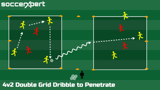
This drill builds the courage to dribble forward and the vision to combine once you get there. Most young players learn to keep the ball. Fewer learn when to carry it into space on purpose. Here, attackers hold a 4v2 advantage in one grid until a gap opens. Then one player has to make a bold read: drive the ball across open space into a second group and keep the play alive. It is a great tool for coaches who want players who dribble with a purpose, not just to beat a defender for the sake of it. Along the way, players practice supporting angles, scanning before the ball arrives, and staying patient in tight numbers-up possession. Add pass or touch restrictions once players get comfortable, and this drill turns into a real tactical test of speed of play and decision-making under pressure.
 Medium
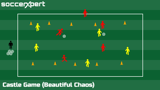
This game is chaos on purpose. Two balls are live at the same time, so players cannot lock onto one thing and switch their brain off. They have to scan, talk, and decide fast. That is the whole point. Each team guards five cones on their own end line. Each team tries to knock over the other team's cones with the ball. Knock one down, sprint it back to your castle, and it belongs to you. Simple rules, and the players get it in about thirty seconds. What you get out of it is much bigger than the rules suggest. Players learn to keep their head up because a second ball can hit them from behind. They learn to pick a pass instead of blasting it, because an accurate ball knocks a cone over and a wild one does not. They learn to shift from attack to defense in a heartbeat, since both happen at once. And the sprint rule turns this into real conditioning without a single line drill. Nobody stands around. Nobody asks how much longer. Use it as a warm-up, a mid-session energizer, or the last twenty minutes when legs are tired and you still want quality touches. It fits U6 all the way to adults. You only change the grid size and the number of balls. Coaches, resist the urge to over-coach this one. Let it get loud. Step in for a quick word, then let them play. The best learning here happens on its own, and the kids will ask for it again next week.
 Medium
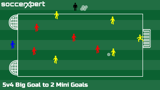
This game-like drill creates a high-tempo match situation to challenge both attackers and defenders. Attackers learn how to break through a compact defense to create finishing chances on the big goal. Defenders focus on applying pressure, staying compact in central spaces, and protecting the penalty area. When defenders win the ball, they must transition immediately to find the two mini goals or connect with the neutral target. The neutral player keeps the pace high and gives both teams an outlet to reset and switch the attack.

 Premium